


What is a Filter Press?
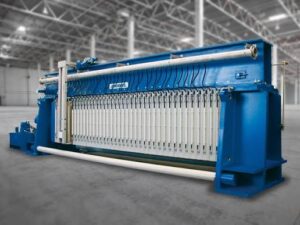
A filter press is an industrial solid–liquid separation machine used to remove suspended solids from a liquid by applying pressure through a series of filter plates and filter cloths.
It is one of the most common technologies for producing a relatively dry filter cake from a slurry.
How does a filter press work?
The basic process is:
Slurry → Pump → Filter chambers → Filtration → Cake formation → Cake discharge
- Slurry feeding
- A slurry containing liquid + solid particles is pumped into the filter press under pressure.
- Filtration
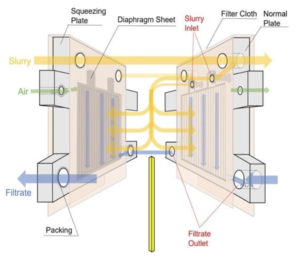
- The slurry enters chambers formed between filter plates.
- The filter cloth allows liquid to pass through but retains the solid particles.
- Cake formation
- Solids accumulate on the cloth and form a filter cake.
- As the cake becomes thicker, filtration resistance increases.
- Filtrate collection
- The clarified liquid passes through the cloth and exits through internal channels in the plates.
- Cake dewatering
- Depending on the design, additional pressure can be applied using:
- Feed-pump pressure
- Membrane squeezing
- Air blowing
- This reduces the moisture content of the cake.
- Depending on the design, additional pressure can be applied using:
- Cake discharge
- The plates are opened and the solid cakes fall or are mechanically removed.
Main components
A typical filter press consists of:
| Component | Function |
|---|---|
| Filter plates | Form the filtration chambers |
| Filter cloths | Separate solids from liquid |
| Filter frame | Supports the plates |
| Hydraulic closing system | Keeps plates compressed |
| Feed pump | Pumps slurry into the press |
| Filtrate channels | Collect filtered liquid |
| Cake discharge system | Removes filter cake |
| Control system | Controls pressure, cycle and operation |
| Optional membrane plates | Further dewater the cake |
Filter Press Applications
Filter presses are used whenever a process produces a solid-containing slurry that needs to be separated into a liquid and a solid cake.
- Cement industry
- Mining and mineral processing
- Metallurgy
4. Steel industry
5. Chemical industry
6. Food and beverage industry
7. Ceramic industry
8. Wastewater treatment