


The indusrties mostly harm waters, soils and air. Now a days there are several ways to protect the enviroments from these harms of the industries . But we want to focus on the air polution in industries.
The air polution by industries are in 2 main categories. Dusts and chemical gas or mixtures of them. For poluting these harmful phenomonen there are different types of filters that are installed in the plants which can reduce(not compeltly eliminate) the dangers of them.
Below you will find a brief explanation of each and their applications.
air and gas filters are essential for protecting equipment, people, and the environment by removing dust, particulates, and contaminants from air or process gases.
Here’s a clear and complete overview of the main types of air and gas filters, categorized by function and application:
- Mechanical Filters
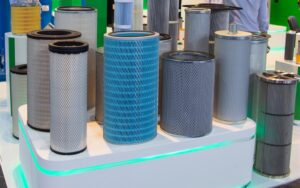
These remove solid particles (dust, pollen, fibers, etc.) from air or gas streams using physical barriers.
🔹 Types:
- Pre-filters / Coarse Filters:
Capture large dust and debris. Often the first filtration stage (e.g., G2–G4 in EN 779 or ISO coarse filters).
→ Used in HVAC systems, compressors, and air intakes. - Fine Filters / Secondary Filters:
Capture smaller particles like fine dust and spores (e.g., M5–M6 or ISO ePM10).
→ Used after pre-filters for better air quality. - HEPA (High Efficiency Particulate Air) Filters:
Remove 99.97% of particles ≥0.3 µm.
→ Used in hospitals, cleanrooms, and pharmaceutical or electronic industries. - ULPA (Ultra-Low Penetration Air) Filters:
Even higher efficiency (≥99.999% for particles ≥0.12 µm).
→ Used in semiconductor or nuclear applications.
- Chemical / Gas-Phase Filters
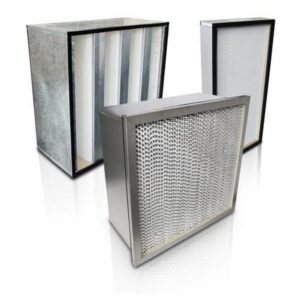
Designed to remove gaseous pollutants like VOCs, SO₂, NOₓ, and odors.
🔹 Types:
- Activated Carbon Filters:
Adsorb organic gases and odors via carbon granules or impregnated carbon.
→ Used in air purification, chemical plants, and gas treatment. - Impregnated Alumina / Potassium Permanganate Filters:
Oxidize or neutralize acidic and basic gases.
→ Used in laboratories, refineries, and data centers. - Catalytic Filters:
Use catalysts to convert harmful gases (e.g., CO → CO₂).
→ Used in engine exhausts and industrial gas cleaning.
- Electrostatic Filters
Use electrical charges to capture particles.
🔹 Types:
- Electrostatic Precipitators (ESP):
Charge and collect dust particles on plates.
→ Used in power plants, cement kilns, and steel industries. - Electronic Air Cleaners:
Smaller versions for HVAC or air purifiers.
→ Used in buildings and clean environments.
- Bag Filters / Cartridge Filters
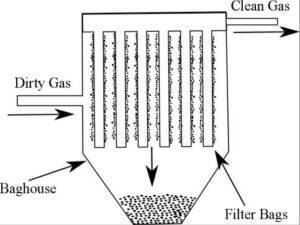
Capture dust and particulates from industrial process gases.
🔹 Types:
- Bag Filters (Bag House Filters):
Dust-laden gas passes through fabric bags; particles remain on the surface.
→ Used in cement, steel, and chemical industries.
(Common materials: polyester, PPS, Nomex, PTFE, fiberglass.) - Cartridge Filters:
Compact cylindrical filters made of pleated material for higher surface area.
→ Used in gas turbines, compressors, and dust collectors.
- HEAT-Resistant / High-Temperature Filters
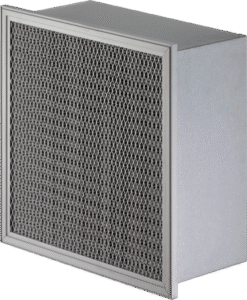
Operate at elevated temperatures (up to 400–600°C).
🔹 Examples:
- Ceramic Filters: For hot gas filtration in incinerators and kilns.
- Metal Mesh Filters: For gas turbines and process gas protection.
- Coalescing Filters
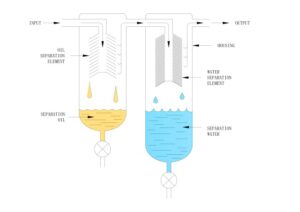
Separate liquids (oil, water droplets) from compressed air or gas.
→ Used in air compressors, pneumatic systems, and natural gas processing.
- HEPA + Activated Carbon Combination Filters
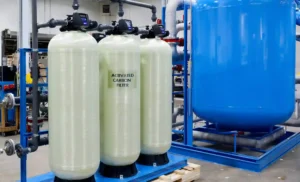
Hybrid filters combining particle and gas filtration, common in HVAC or clean air systems.
- Molecular Sieves & Membrane Filters
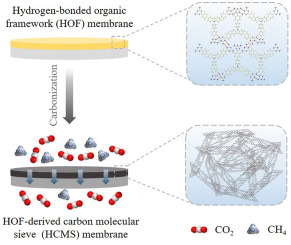
Used for gas purification and separation at the molecular level.
→ Used in oxygen/nitrogen generation, natural gas dehydration, and hydrogen purification.
Industry Examples
| Industry | Common Filter Types |
|---|---|
| Cement | Bag filters, ESP, cartridge filters |
| Chemical / Petrochemical | Activated carbon, coalescing, cartridge |
| Power plants | ESP, HEPA, SCR catalysts |
| HVAC / Cleanrooms | Pre, fine, HEPA, ULPA |
| Food & Pharma | HEPA, activated carbon, sterile air filters |
| Gas processing | Coalescing, molecular sieve, membrane |
9- Filter Press
What is a Filter Press?
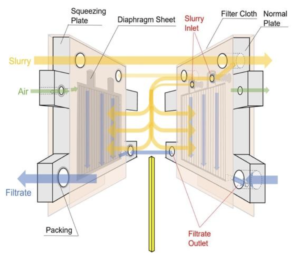
A filter press is an industrial solid–liquid separation machine used to remove suspended solids from a liquid by applying pressure through a series of filter plates and filter cloths.
It is one of the most common technologies for producing a relatively dry filter cake from a slurry.
How does a filter press work?
The basic process is:
Slurry → Pump → Filter chambers → Filtration → Cake formation → Cake discharge
- Slurry feeding
- A slurry containing liquid + solid particles is pumped into the filter press under pressure.
- Filtration
- The slurry enters chambers formed between filter plates.
- The filter cloth allows liquid to pass through but retains the solid particles.
- Cake formation
- Solids accumulate on the cloth and form a filter cake.
- As the cake becomes thicker, filtration resistance increases.
- Filtrate collection
- The clarified liquid passes through the cloth and exits through internal channels in the plates.
- Cake dewatering
- Depending on the design, additional pressure can be applied using:
- Feed-pump pressure
- Membrane squeezing
- Air blowing
- This reduces the moisture content of the cake.
- Depending on the design, additional pressure can be applied using:
- Cake discharge
- The plates are opened and the solid cakes fall or are mechanically removed.
Main components
A typical filter press consists of:
| Component | Function |
|---|---|
| Filter plates | Form the filtration chambers |
| Filter cloths | Separate solids from liquid |
| Filter frame | Supports the plates |
| Hydraulic closing system | Keeps plates compressed |
| Feed pump | Pumps slurry into the press |
| Filtrate channels | Collect filtered liquid |
| Cake discharge system | Removes filter cake |
| Control system | Controls pressure, cycle and operation |
| Optional membrane plates | Further dewater the cake |
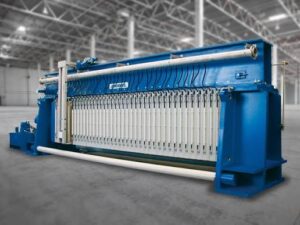
Filter Press Applications
Filter presses are used whenever a process produces a solid-containing slurry that needs to be separated into a liquid and a solid cake.
- Cement industry
- Mining and mineral processing
- Metallurgy
4. Steel industry
5. Chemical industry
6. Food and beverage industry
7. Ceramic industry
8. Wastewater treatment